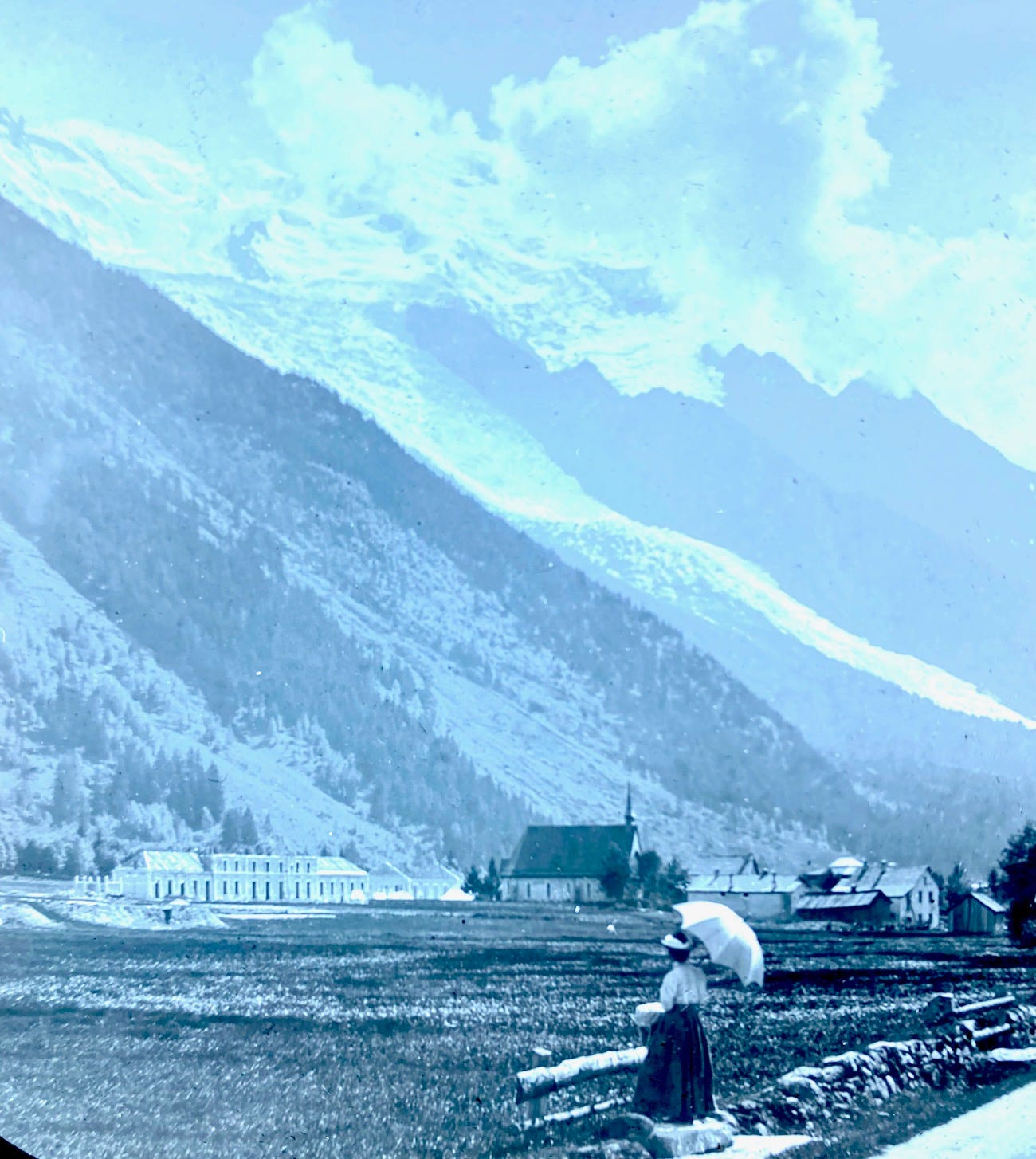
Peak Viewing in Post Revolutionary France
A 60 hour stagecoach journey, French food, ghosts & volcanoes 1829.

Last month I transcribed the letters of a young mother stricken with grief at having to leave her children in South Devon while she explored the delights of North Devon with her husband. In her second letter she wrote of her journey into neighbouring Somerset by stagecoach. This month, I feel I should stay with stagecoaches, but maybe step up a gear, so I’m turning to the letters of Edward Stanley. Edward was a vicar, and 8 years after the death of Napoleon he travelled across France by stagecoach in order to see a volcano. It was an extremely arduous journey for a Victorian Vicar in his 50’s, but he coped with the rigours of travel remarkably well and with an amazing good humour. He wrote to his wife Kate, still at home at the Rectory at Alderley, near Congleton in Cheshire.
“What should I think of myself were I to put myself in the stage coach & go from Alderley to London & back to Alderley & back again to London without stopping and after 5 hours sleep set out with the purpose of ascending a mountain higher than Snowdon – all of this have I done since leaving Paris on Friday at 2 o’clock, and strange to add without experiencing anything like fatigue or being the whit the worse.
To be sure the French Diligence has advantages an English coach has not. By taking the outside place with the conductor on the roof you have the benefit of the easiest seat possible. This part holds only 3 in a space which in England would be assigned to 4, so there is ample room for stretching the legs … and my air cushions were the greatest luxuries in the world.
It was not till attaining the heights above Chateauneuf that the range of the Puy de Dôme hills appeared … As we approached the country improved for hitherto a more uninteresting vile series of scenery can scarcely be imagined … at ¼ after 1 AM on Monday 15th after 60 hours travelling, we arrived at Clermont & actually I felt a little drowsiness.”
I think I should point out that Edward was not a typical parish priest. As a child his father had forbidden his entry into the Royal Navy and so it seems a strange choice to us that, as an alternative choice of career, he should pick the Church. The Dictionary of National Biography describe him as “having a natural aptitude for science” and say he was “a student of such subjects as ornithology, entomology, minerology and geology … He was one of the first clergymen who ventured to lecture on the then suspected science of Geology”. Imagine then the excitement felt by this serious student of science when he first caught sight of the Puy de Dôme volcano after his 60 hour non-stop journey.
“I had seen the Puy de Dome looming over the town as we approached & was anxious to see how he looked in the daylight. There he rises about 6 miles off like an enormous wart, Lord and King over a host of minor warts all around him. He has neither picturesque form or character to recommend him. An unbroken mass of green grass. But he is nevertheless highly reputable & I did not presume to pass a verdict against him till I had formed a more intimate acquaintance with him. So after taking a hasty view of the irregularly large rambling town of Clermont, I sallied forth with a guide & after riding a wretched beast of a horse who had scarcely a leg to stand upon, (rode) about 3 miles to a village Barriaque. I took a mountain guide and proceeded on foot.
The actual ascent is very steep, & required a severe pull under a hot sun for about an hour and ¾. The view from the summit gives a perfect idea of what was going forward when the volcanoes were at work. The cones lay stretched below, all the same uninteresting form, mostly covered with grass… We returned by another road through a village called Royat, with which it would be unfair to find a single fault. Conceive a wide gorge bounded by these volcanic ranges, filled with the richest woods and the most delightful crystal streams and a flat roofed Italian looking village nestled in the snuggest mass of verdure. It is on green shady patches of this heavenly valley that the good people of Clermont assemble for picnic dinners and fetes champetres. The village of Royat is dirty enough but its church is an old Roman Castle, & it has a basaltic grotto … in which a parcel of picturesque old hags were washing in a stream formed by the sills bursting from the sides and roof. As for Clermont itself, it is situated on the descent of this hilly range, and like Pau has its promenade commanding a splendid view of the vales and hills which surround it, filled with little villas or cottages pushed in midst vineyards without end. In short I do not suppose it possible to conceive a spot more worthy of being called the Garden of Nature.
Tell Mary I have not seen a single rare butterfly or insect which rather surprises me & my nippers have never been in requisition,”
Four days later, not feeling at all the worse for wear after all his physical exertions he again wrote to his wife.
“This week … my physical powers have been largely drawn upon, and I am happy to say not only without the slightest injury, but with actual benefit, for I do not recollect for years that I have been so perfectly free from giddiness, bile and all such sort of nuisances. My letter from Clermont the day of my arrival, Monday last, will, I hope have set your mind at ease as to my having well weathered the journey. Now for subsequent adventures. Well on Tuesday morning at 8 o’clock in a villainous cabriolet with a wretched horse and stupid fellow of a driver who had never been on the road before, I set out for the baths of Mont-Dore, distance by the Grande route about 30 miles. Nothing could be more uninteresting than the whole way to a miserable village where we stopped to bait the horse, called Rochfort (I’m not sure of the horses name, but the Village is now called Rochefort-Montagne), the Puy de Dome round and ponderous was the only prominent feature. The rest of the country reminding me of the dullest parts of Cumberland, immense tracts of grass, or mountain cow land, the minor hills not sufficient to enliven the unvaried weariness of the scene. My heart sunk within me, the prospect was dismally hopeless. For 5 or 6 miles beyond Rochfort( where with the exception of two little trouts fried in wine & onions I never ate a worse dinner; rags of beef so tuff as to set my teeth at defiance & a thing called a leg of lamb … stringy & lean & muscular & dry & so like the leg of a dog that I have my doubts whether it was not a canine. For want of better occupation I tried an ornithological experiment on a parcel of fowls under the window, feeding them with the above meat to ascertain whether they were carnivorous as well as granivorous, when I had the satisfaction of proving beyond doubt that they were so. An old game cock voraciously gobbling up the beef, while his harem of hens contested for pieces of lamb) the country did not improve, at length however we turned out of the high road towards our left and we had not proceeded a mile before I was revived with better hopes. Trees and meadows of a Pyrenean character & fine hills on either side presented themselves, higher mountains began to show themselves & a pic (peak) in the distance here and there with a patch or two of snow gave token of good hope. The evening was, however now gathering in & vast clouds came rolling down leaving only indistinct views of ghostly forms of rocks and headlands, the thunder began to mutter around the pics. Lightening became every instant more vivid till it ended in our being exposed to a splendid hurly burly of the elements. We were soon in utter darkness with the exception of the occasional flash of lightening … the horse knocked up with the torrents of rain & it was not till 10 O’clock that the appearance of an old woman with a lantern that I found myself in the village of Mont-Dore, where I had a good reason for believing that I had fairly come into contact with 3 bona fide ghosts. In a flash I suddenly beheld 3 yellow pale looking objects in motion, evidently walking, of a somewhat pyramidical form. From the upper points of which radiated a toupee of considerable dimensions. They proved to be thatched men. That is to say, peasants, returning from Mont-Dore, who on the account of the rain, had actually formed coverings of straw, which uniting at the top were tied close, perfectly excluding rain. I swallowed some bread and milk and went to bed as soon as I could, impatient for the dawn to see what sort of nook in the wide world I was inhabiting.”
When Edward Stanley said dawn, he wasn’t kidding. With a desire to explore and see the sights he had set out to see, he was up very early indeed.
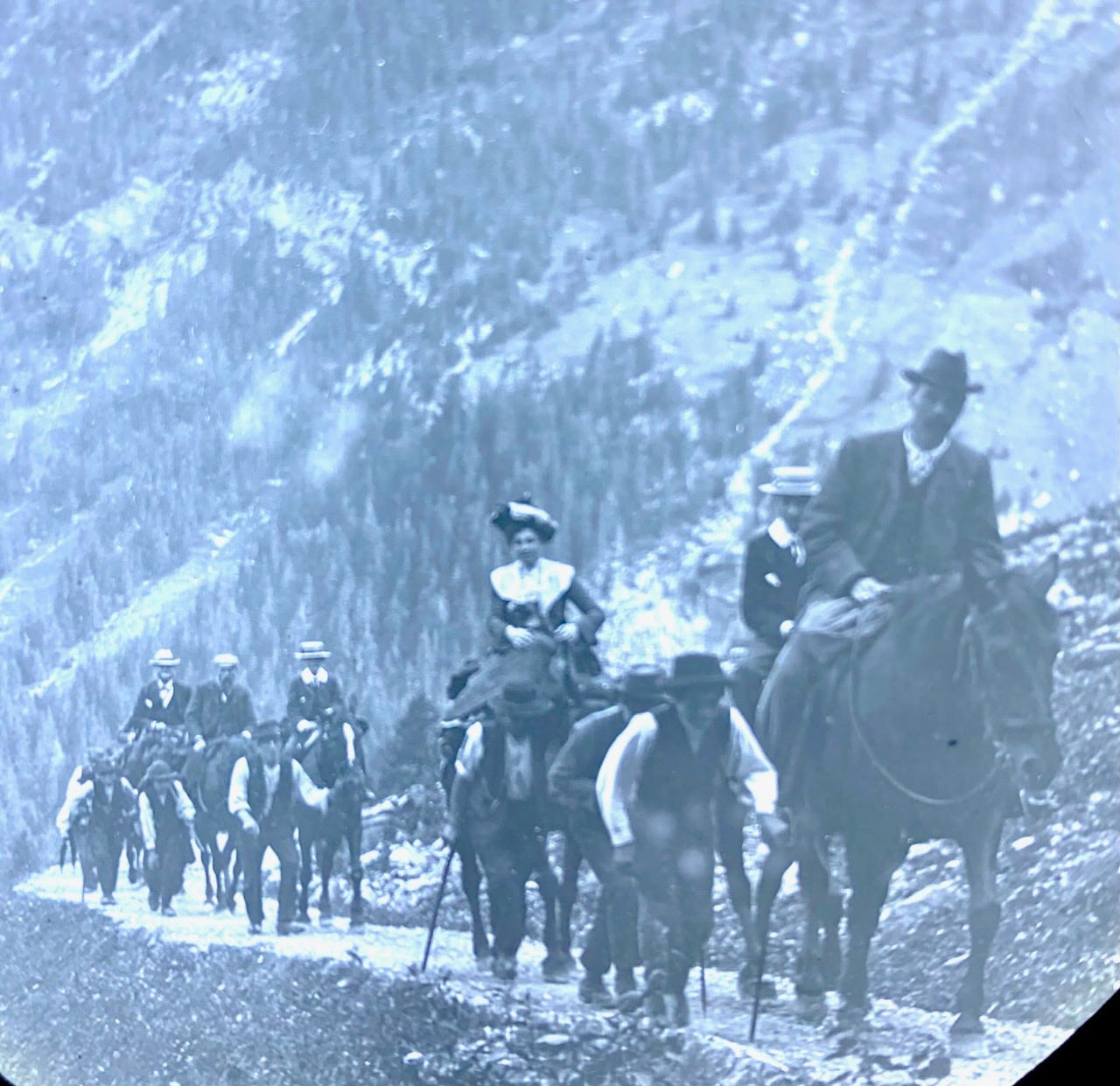
“With the dawn, that is to say before 4 , I was on the alert. Mont-Dore … is a ragged village … but it has its comforts in 4 or 5 of as good hotels as travellers need wish for, each capable of containing 80 to 100 guests, in fact, during the season every hole and corner is full & about 800 are collected. … With a good guide & a couple of horses I sallied forth to see as much as possible in a given time … suffice it to say the scenery could not be surpassed. At 12 we returned when I ate my dinner, aided the horses & we then sallied forth again, it being my determination to ascend the pic de Sancy, the highest point in the extremity, as well as to visit a singularly wild spot called the Gorge du Diable. Away we trotted up the vale (but) having obtained a certain point we consigned the horses to the care of an urchin looking after his sheep, who was to meet us on our descent. Up I scampered, the guide, a fine looking fellow evidently not accustomed to such rapidity of motion. The fact was, clouds began to gather as we ascended, thickening when halfway up. The guide threw out strong hints that further proceedings were useless, that we should see nothing & be thoroughly wet. “That may be”, thought I “but it may also be that the clouds may disperse, & that they are mainly capping the pics” so I pushed on on spite of remonstrances till we were so thoroughly enveloped in mist that I could not see a yard before me. I perceived however, once or twice a looming of the crags above, a sure sign to me that the cloud was not of uniform & permanent density, so again I persevered in spite of the guide & amply was I rewarded for suddenly this vast conglomeration of cloud divided or packed itself up somehow or other and under the clearest sky & finest weather I saw the pic of Cenery rising above me & the whole plain of Auvern & Cantal stretched like a map below. It was a glorious panorama indeed, but little was I prepared for what followed. I had scrambled up a grassy ascent, when lo, it terminated abruptly & I stood on a crest of a precipice having below me the whole volcanic fraction of Cerney with a frightful yet magnificent display of minor aguilles & pics black and gloomy as the day when fire gave them birth, or rather some months after that period as no doubt when the Fire King reigned paramount, they must have been all red hot and vastly like pandemonium. Having recognised the horses at the foot of the pic we proceeded to the gorge of de Diable, which explains itself, a wild demony horrible looking vale, terminated by an inaccessible barrier of frightful rocks”.
Having returned to his hotel, he bad farewell to his guide, climbed above the village to see a a couple of waterfalls, before going off to the explore the thermal baths and listening to a short lecture about their content and healing qualities, before settling down and writing the above letter, which ends,
“What I saw in one day would cut up into ample work for a week in the usual way in which travellers at watering places, with time on their hands usually see these things.”
Nobody could argue with that!
Edward Stanley became Bishop of Norwich in 1837 and vigorously set about shaking up what was a “by-word for laxity and irregularity”. He staunchly championed reforms in education and, unlike many in his position, regularly attended the Houise of Lords, “His most telling speeches were delivered on defence of the government scheme of education … He was the first Bishop who interested himself in the movement for ragged schools … In August 1849 he started for a tour of Scotland with his wife and daughters … he was taken ill and, after a few days died from congestion of the brain”. (DNB)
Sometimes, after writing a substack, I feel I have that too!